Key Takeaways
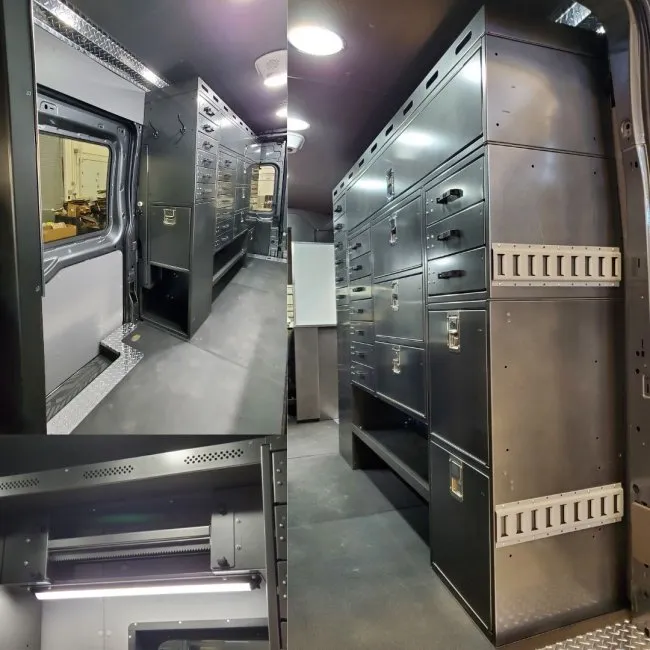
Vehicle storage cabinets are a key part of mobile command centers used in first responder operations such as law enforcement. In this blog, D&R Electronics Co. Ltd., a major fleet vehicle solutions provider based out of Bolton, Ontario, explores key factors to consider when selecting vehicle storage cabinets, types, and more in this blog.
What Are Vehicle Storage Cabinets In Mobile Command Centers?
Role Of Storage Systems In Command Vehicles
Storage systems are a vital part of command vehicles as they are responsible for organizing equipment, protecting gear and personnel, and ensuring rapid deployment for mission-critical operations. It ensures better performance and efficiency for first responders.
Why Organization And Accessibility Matter?
Organization and accessibility emerge as the key benefits of well-designed storage vehicles in command vehicles, as they save precious time for first responders and help optimize their tasks during on-road operations.
Common Equipment Stored In Mobile Command Centers
To design proper storage for mobile command centers, it is first important to understand the type of equipment stored in such a facility. Most mobile command centers typically have advanced communication systems, surveillance equipment and supporting IT infrastructure. Examples include satellite or radio communication systems, modular workstations, and power stations.
Key Factors To Consider When Choosing Vehicle Storage Cabinets
Vehicle Size And Interior Layout
What are the dimensions of the vehicle within which the vehicle storage cabinets need to be integrated? Moreover, the purpose or role of the vehicle dictates what should be in the vehicle and thus generalises an interior layout; however, specific conditions and customization dictate optimization and efficiency of the vehicle. These are the fundamental decisions to consider as they will determine the dimensions of the cabinets and their configuration so that they boost performance in mission-critical operations.
Storage Capacity Requirements
The storage capacity requirements are also a major part of designing ideal storage cabinets for command centers. Detailed information on the type of inventory to be stored on board helps determine capacity requirements. Furthermore, storage of specialized gear or equipment must also be taken into consideration while planning capacity.
Material Durability And Weight Considerations
Material durability is vital for choosing vehicle storage cabinets as it will determine their longevity, vibration handling capacity from the road, and resistance to harsh climatic conditions. While the material has to be robust, weight considerations complicate the matter as the material cannot be too heavy to hinder vehicle operations.
Accessibility And Workflow Efficiency
The storage cabinets also determine accessibility to key equipment. Which equipment needs to be readily accessible and which can be retrieved at a less urgent pace majorly decides workflow efficiency in a command center.
Safe And Secure Locking Systems
Safety and security are major considerations as the sensitive equipment must be secure enough to be protected from sudden movements. Additionally, from a safety standpoint, any equipment must not turn into a projectile and endanger personnel working in proximity.
Modular And Customizable Configurations
Is there a requirement for the storage to expand or be customized in a specific way for future operations? If there is such a possibility, then modular storage solutions must be considered, as they can be scaled as required.
Types Of Vehicle Storage Cabinets And Accessories For Mobile Command Centers
Drawer-Based Storage Systems
Drawers are one of the most versatile vehicle storage systems. They can be used to secure sensitive equipment such as electronics. Can be customized for accessibility and protection for on-road operations.
Overhead Storage Cabinets
Overhead storage cabinets are a more specialized form of storage system in mobile command centers, which primarily store lightweight products, documents, or safety gear. This design supports ergonomics as procuring lighter items from a height is more comfortable for first responders. Apart from not disturbing the center of gravity of the vehicle.
Equipment Racks And Mounts
Racks and mounts are a great way to save valuable floor space in a mobile command center. They can store bulkier items and offer easy access to important tools, safety vests and miscellaneous equipment.
Slide-Out Trays And Compartments
Slide-out trays and compartments are designed for more heavy-duty usage in a mobile command center. They are equipped to store and transport heavy gear such as generators, pumps or heavy-duty rescue equipment. Their design supports safe and comfortable loading/unloading for first responder personnel.
Electronics And Communication Equipment Storage
To secure electronics and sensitive equipment, a more specialized storage system is required, which will ventilate and dissipate heat and have enough securing anchors to secure equipment and channels for routing wires as required. These enclosures ensure safe and effective storage of electronics and communication equipment, allowing easy retrieval and access. It ensures protection from vibrations and movements when stored within the cabinets.
Cable And Accessory Management Systems
Electronics and communication equipment come with a range of cables and related accessories. A variety of cable management systems, such as cable frames, grommets, trays, hooks, holsters, and organizers, are used in this case.
How To Choose The Right Cabinet Layout For Your Command Vehicle?
Step 1: Identify Operational Requirements
Operational requirements are a prerequisite for selecting the right cabinet layout. This includes planning the layout for the command centers and assessing the vehicle dimensions.
Step 2: List Essential Equipment And Tools
What equipment and gear are the cabinets designed to store? This could range from weapons to communication systems, surveillance equipment or other miscellaneous items. These tools and devices will also determine the design and selection of cabinets.
Step 3: Plan Storage Zones By Usage Frequency and Weight Distribution
The next step involves planning appropriate storage zones for the cabinets. The biggest factor to consider here is usage frequency. Equipment that is utilized frequently and is needed urgently for on-field operations must be prioritized first for storage. The cabinets must be designed to provide easy access to this important equipment first. The plans should consider that an even distribution of weight closer to the front of the vehicle is better than farther back in the vehicle. Heavy equipment lower to the ground is better than higher above the ground. These considerations make for a safer build.
Step 4: Optimize Accessibility And Movement
Of course, storage cabinets must also consider accessibility and movement of the personnel within the mobile command center. For instance, heavier equipment must be stored closer to the floor for easier access, and the vehicle storage cabinets must not obstruct the movement of first responders.
Step 5: Evaluate Mounting And Installation Options
Based on the dimensions and layout of the mobile command center, consider where the cabinets will be mounted. Moreover, it is also important to take into account whether the installation of mounting brackets or subframes is required to secure the storage system to the chassis backbone of the vehicle. This is an essential operation.
Step 6: Finalize Modular And Expandable Features
Lastly, consider whether it will be a better choice to go for a modular cabinet design. This will make it easier to add or remove vehicle storage cabinets if required. Furthermore, consider features such as expanding drawers or spaces to further utilize storage within the mobile command center.
Materials Commonly Used in Vehicle Storage Cabinets
Aluminum Storage Systems
Aluminum and aluminum alloys are an excellent choice for storage systems as they are known for their lightweight and non-corrosive properties. They also exhibit excellent tensile strength, making them a solid choice for vehicle storage cabinets.
Steel Storage Cabinets
In terms of rigidity and longevity, nothing can compare to steel for storage cabinets. The durable nature of the material also makes it a perfect choice to counteract the constant vibrations of the vehicle.
Composite And Lightweight Materials
Composite materials such as carbon fibres offer flexibility, insulation and relatively solid durability, along with being lightweight. They are ideal for storing electronics or sensitive equipment.
Corrosion Resistance And Durability Factors
Irrespective of the choice of material, the most vital material considerations for vehicle storage cabinets include corrosion resistance and durability. The balance between these materials will decide the selection of cabinet materials.
Common Mistakes To Avoid When Selecting Vehicle Storage Cabinets
Ignoring Vehicle Weight Limitations and Distribution Parameters
Weight limitations and distribution play a critical role in selecting vehicle storage cabinets. Ignoring the weight limitations and distribution parameters of the vehicle compromises vehicle safety and integrity. Overloading and uneven or wrong distribution can reduce optimum power in a vehicle or compromise braking. An unbalanced load can cause a shift in the center of gravity, causing instability of the vehicle or flipping. Therefore, the balance between weight and durability must never be ignored.
Poor Accessibility Planning
Tiny mistakes with cabinet placement or wrong layouts can have far-reaching consequences. This results in poor accessibility, which, in turn, reduces the overall operational efficiency of first responders.
Choosing Non-Modular Systems
Non-modular systems might end up being the wrong choice in the long run, as they might require expensive refitting to repurpose the vehicle or change the structure to suit additional functionality. The benefits offered by modular storage solutions cannot be overstated.
Benefits Of Vehicle Storage Cabinets From D&R Electronics Co. Ltd.
D&R Electronics Co. Ltd. offers an extensive range of standard vehicle storage solutions in the form of storage cabinets, pull-out trays, equipment trays, vehicle storage accessories, and supporting subframes. They ensure:
- Faster emergency response efficiency
- Improved equipment organization
- Better safety and workflow
- Easier maintenance and inventory management
D&R Electronics Co. Ltd. designs, manufactures, and installs solutions. Hence, customization is not an issue with 50 years of experience supporting Police, Fire, and Utilities across North America and around the globe.
Conclusion: Choosing the Right Storage Solution for Mobile Command Centers
In closing, a lot goes into choosing the right storage solution for mobile command centers, ranging from material selection, layout, accessibility and much more.
D&R Electronics Co. Ltd. is a fleet vehicle solutions provider serving North America, the Middle East, Europe, and Australia. We offer a variety of solutions, including police sirens, emergency vehicle consoles, vehicle storage accessories and cabinets, and more. Contact us at 1-800-538-7338 for more details.
FAQs
What are vehicle storage cabinets used for in command centers?
Vehicle storage cabinets are used as mobile command centers to store various key equipment for on-field operations.
What materials are best for mobile command center storage systems?
The best materials for mobile command center storage systems include aluminum alloys, steel, or composite materials.
How do you organize equipment inside a command vehicle?
To expertly organize equipment in a command vehicle according to frequency of usage, safety and accessibility, invest in proper vehicle storage solutions that are customized for the vehicle.
What features should mobile command center cabinets include?
Mobile command center cabinets must be durable, lightweight, offer optimal organization and the ability to store items safely and securely.
Are modular storage systems better for emergency vehicles?
Yes, modular storage systems are better-suited for emergency vehicles.





 Find a Dealer