Key Takeaways
The role of police sirens in law enforcement vehicles is evident. From alerting other motorists to coordinating emergency response operations, they are vital auditory tools for first responders. Therefore, their selection is equally important to ensure optimal performance and reliability. D&R Electronics Co. Ltd., a major fleet vehicle solution provider in Bolton, Ontario, explores these selection criteria for police sirens in detail in this blog.
Why Siren Selection Matters In Emergency Response Vehicles?
The Role Of Sirens In Emergency Operations
Sirens play a major role in almost all emergency operations. In emergency vehicles, they emit instant, high-decibel sounds to facilitate the right of way for first responders. They are also utilized to communicate between different fleet vehicles.
How Sirens Improve Public Awareness And Response?
Due to the high-decibel, piercing sound emitted by sirens, it grabs the attention of motorists and bystanders in busy traffic areas as well as on highways and in less populated regions.
Risks Of Selecting An Unsuitable Siren System
If the siren system is unsuitable or ineffective, then it might fail to alert other motorists to the presence of an emergency vehicle, leading to hazardous situations for both civilians and first responders.
Understanding The Core Components Of a Police Siren System
Siren Amplifiers
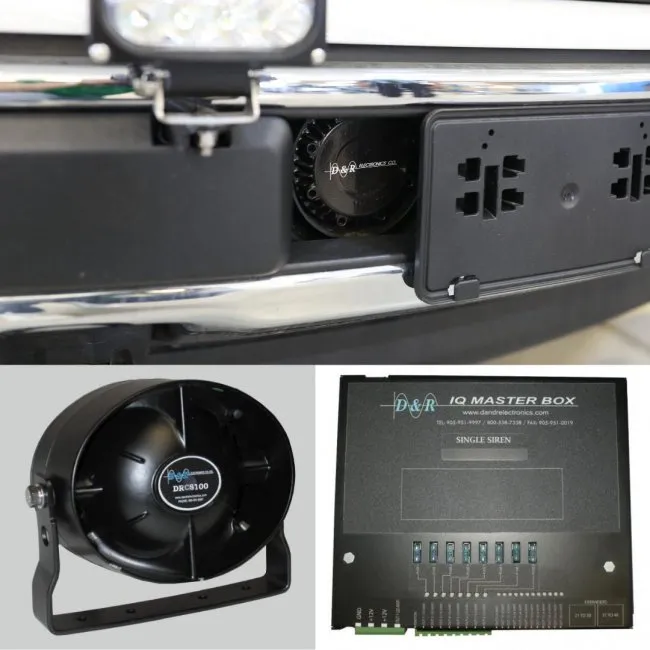
The siren amplifier primarily drives the speaker units. It takes the incoming signal from the control unit and provides a powerful output. This output is then used to effectively run the speakers.
Speaker Units
Speakers emanate the high-decibel sound as required. They typically have a higher impedance than speakers used in regular cars, around 11 ohms. Thus, they can generate the required output without consuming much power. The speakers are mounted on the grille or push bumper.
Control Heads And Switches
The control heads and switches are a physical or digital interface that acts as a dashboard. It allows the law enforcement personnel to activate the system, switch sound patterns, or use the public address system.
Public Address Functionality
The public address system is used in conjunction with the sirens to address the public directly. Officers use it to provide verbal commands to facilitate clear roadside communication.
Common Police Siren Tones and Their Intended Applications
Wail Tone
The wail tone is primarily used when a law enforcement vehicle is approaching from a distance. It has a hi-lo variation to grab the attention of motorists and bystanders. However, the switch between the two tones is slow.
Yelp Tone
The yelp tone is similar in nature to the wail. It also uses the hi-lo frequency sounds to alert people. The main difference is that the switch-up is much faster. It is mainly used in high-traffic areas to get the right of way.
Hi-Lo Tone
The hi-lo, which features in both the yelp and the wail, mainly features a distinct pattern, which is created between a low-pitched and a high-pitched sound. However, it is considered to be not as urgent as either wail or yelp.
Thunder Tone
This is a deep, low-frequency pattern used in areas with high ambient noise. It can penetrate glass and steel, providing a feel factor along with the rumbling sound.
Stinger Tone
The stinger tone is a high-pitched sound that is blasted for very short durations. They are used to break up traffic in congested urban environments.
Key Selection Criteria For Police Sirens
Sound Output And Audibility
The sound output and how audible it is in high-noise environments are critical when it comes to choosing police sirens. The sound emanated by the siren must be loud enough to achieve its end goal, which is to grab attention even when other sounds are present. Apart from the decibel, sound quality also deserves consideration.
Speaker Power And Performance
The speaker must be powerful enough to emanate the high-decibel sound of a police siren. The main feature to consider here is the impedance level, which should be 11 ohms for police sirens. Speakers used for consumer vehicles have a much lower impedance.
Number Of Siren Tones Available
The decibel level emitted by the police siren is important, but so is the number of tones. Based on different situations, the siren should be programmed to emit different sounds, such as wail, yelp, or thunder. The end goal is to always ensure clear communication on the road.
Ease Of Operation During Emergencies
The police siren interface must be simple enough to operate for law enforcement personnel. This ensures quick and effortless operation during emergencies and improves on-road safety.
Weather And Environmental Durability
The external components of the police siren, such as the speaker, must be robust enough to handle inclement weather conditions and the constant vibrations of the vehicle.
Vehicle Compatibility Requirements
Choosing the right police siren system based on vehicle make and model is also paramount. The best-functioning sirens might not provide optimal performance if they are not compatible with the vehicle.
Regulatory And Compliance Considerations
Regulatory and compliance considerations aid in the selection of police sirens. Factors such as hardware certifications, namely SAE Class A, impedance level and watt ratings fall under this category.
Choosing The Right Siren Based On Vehicle Type
Marked Police Vehicles
The standard police cruiser or vehicle uses a typical multi-tone electronic siren. This is the standard siren with a 100 to 200-watt rating. The speakers for these police sirens are mounted on the push bumpers or grilles of the marked police vehicle.
Unmarked Enforcement Vehicles
Unmarked enforcement vehicles also use the 100-watt police sirens. However, the speaker of this system might be hidden, as stealth is a key outcome during covert operations.
SUVs And Specialty Units
SUVs and specialty units also utilize the 100-watt police siren with different programmable features and sound patterns. However, the mounting of the speaker units might vary significantly from a standard police vehicle.
Step-by-Step Police Siren Selection Process
Step 1: Define Operational Requirements
The first step involves defining the operational requirements of the police siren. Most sirens must have a decibel level of 120 or above, and a power output of about 100 watts. Additional requirements and mounting considerations must be mapped out for better compatibility.
Step 2: Assess Vehicle Specifications
What type of vehicle is the police siren for? Is it a marked police vehicle, a stealth vehicle, or a large unit, such as an SUV? According to this, the selection of a police siren will differ, mainly in terms of mounting and associated hardware.
Step 3: Determine Sound Coverage Needs
Is there a requirement for louder police sirens? A 200-watt siren will be louder than a standard 100-watt one, but selection will depend on the requirement and cost. If the sound needs to cover larger distances, a 200-watt siren can be considered.
Step 4: Compare Available Siren Features
Compare the features of police sirens from different fleet vehicle solution providers, such as tone variety, integration with the lighting system, ease of use, and more.
Step 5: Verify Compliance Requirements
Make sure that the police siren is up to code in terms of compliance requirements. Most law enforcement sirens must meet certain criteria before they are considered viable.
Step 6: Plan Installation And Testing
Ensure you test the siren before and after installation. This is key for on-field reliability under challenging conditions.
Advanced Features Found in Modern Police Sirens
Integrated Lighting Controls
Modern police car sirens are designed to be integrated with lighting controls. This ensures that both sound and light are used in tandem to alert and communicate on the road.
Programmable Siren Functions
Siren functions are programmable for different situations, such as thunder for low-frequency vibrations in high-noise environments, or wail for sound coverage over large distances.
CAN Bus Integration
CAN bus integration is a major upgrade to police sirens in modern vehicles. It connects the equipment directly to the vehicle’s internal communication network. This simplifies wiring and installation.
Maintenance Considerations For Long-Term Reliability
Routine Siren Testing
Test the siren system routinely to see if it is in optimal condition. Do a routine inspection to check for broken knobs or buttons, as they are the most likely to require replacement.
Electrical Inspections
Make sure all the electrical connections are in place, and the wires are not damaged or burned out.
Speaker Maintenance
Since the speaker is exposed to the elements, make sure to clean it regularly and check for signs of water or dust ingress.
Conclusion
Making An Informed Police Siren Selection
In the end, making a proper selection of a police siren requires a deep understanding of function, vehicle compatibility, compliance requirements, and more.
To learn more about police car sirens and which one is right for your fleet, contact us at D&R Electronics Co. Ltd. today. As a leading fleet solution provider in North America, the Middle East, Europe, and Australia, we offer a variety of solutions, including vehicle storage cabinets, emergency vehicle consoles, and more. Contact us at 1-800-538-7338 for more details.
FAQs
What is the best siren tone for police vehicles?
There is no specific siren tone that is considered best for police vehicles. The right tone depends on different situations.
How loud should a police siren be?
A typical police siren should produce sound at around 100 to 120 decibels.
Can sirens be integrated with emergency lights?
Yes, sirens can be integrated with emergency lights via a physical or digital dashboard.
What affects siren performance in traffic?
Siren performance is affected in traffic by external traffic noise, vehicular soundproofing, ambient noise, and atmospheric absorption.
How often should police siren systems be inspected?
Ideally, police siren systems should be inspected visually on a daily basis. Functional testing can be conducted weekly. A comprehensive quarterly and annual inspection is also recommended.





 Find a Dealer