Introduction
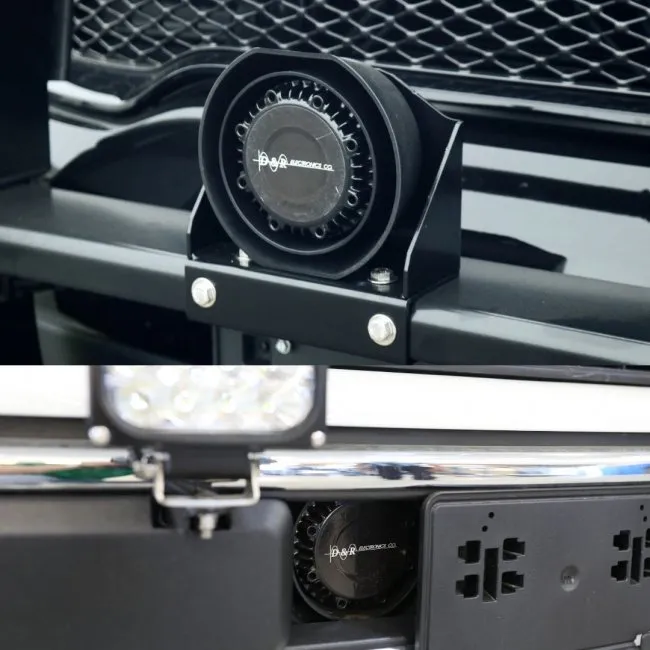
Police sirens are a key part of law enforcement vehicles, ensuring alertness and clear communication among police personnel. Most standard police sirens have 100 Watt (W) ratings, but 200 Watt ratings are not unheard of. What is the difference between the two types of sirens? D&R Electronics Co. Ltd., a major fleet vehicle solutions provider in Bolton, Ontario, offering emergency vehicle LED lights, vehicle storage cabinets, power distribution units, and more, explores the differences between the two types of police sirens in this blog.
What Do 100 W And 200 W Police Sirens Mean?
Understanding Siren Wattage
Siren wattage is a key metric when it comes to police sirens used in emergency vehicles. In a nutshell, it is the electrical output of the siren’s amplifier system, which, in turn, drives the speakers.
How Amplifier Power Relates To Siren Output
Amplifier power is connected to the siren output, as higher amplifier power typically means that the siren can drive more sound through the speaker. Therefore, sirens with higher wattage can be used with larger amplifiers, requiring more power to generate more sound. However, by no means is this the only criterion for determining siren output.
Why Wattage Alone Does Not Determine Performance
While the wattage of a police siren is an important consideration, the overall performance of the equipment depends on a multitude of factors. Some prominent ones include the quality of the speakers themselves, where they are mounted on the police cruiser, the size of the vehicle on which it is mounted, and the environmental conditions in which the vehicle and siren operate.
How Do 100 W And 200 W Sirens Compare?
Sound Output And Audible Range
In terms of pure sound output and audible range, 200 W sirens are more powerful than their 100 W counterparts. When volume is considered, 200 W sirens are only slightly louder than 100 W sirens. However, in terms of audible range, the former almost doubles the latter.
Performance In Urban And Rural Environments
While 200 W sirens exhibit better performance on paper, 100 W sirens are the standard as they are perfectly capable in urban environments. In city or suburban regions with standard vehicles, 100 W police sirens are effective at on-road communication. 200 W has an edge only on highways, where one is exposed to larger vehicles such as semi-trucks.
Effect Of Traffic, Weather, And Background Noise
In heavy traffic environments and modern vehicles with stronger insulation, the 200 W sirens can have a better impact, as they can pierce through the noise of ambient traffic and background noise. When weather is considered, 200 W sirens are marginally better in inclement weather, but suffer similar environmental sound attenuation as 100 W sirens.
Power Consumption And Electrical Requirements
100 W sirens have a relatively lower power demand than 200 W sirens.
Physical And Installation Considerations
Due to higher power consumption, the 200 W sirens have more complex installation considerations than their 100 W counterparts.
When Is A 100 W Police Siren Suitable?
Standard Police Patrol Vehicles
Standard police patrol vehicles found in urban environments, such as sedans and security vehicles, can perform adeptly with 100 W sirens.
Urban Emergency Operations
Urban emergency operations require lower speeds and shorter-distance travel. Therefore, sound projection needs are also not very high, making 100 W sufficient.
Short-Distance Warning Requirements
As mentioned above, in urban and suburban environments, the police cruisers need to alert other motorists or bystanders situated across relatively short distances. Since sound propagation needs are met with 100 W sirens, they are adequate in these conditions.
Situations With Moderate Ambient Noise
Even in urban conditions where there is low to moderate ambient noise, 100 W police sirens are a better choice for most standard police vehicles. They are also easier to install and offer a more efficient system design.
When Is A 200 W Police Siren More Appropriate?
Highway And High-Speed Operations
On highways, there are vehicles moving across large distances at much higher speeds than in urban environments. This requires a stronger police siren, which can propagate sound across long distances, making 200 W sirens a suitable choice.
Heavy Traffic And High-Noise Environments
Similarly, in urban environments where heavy traffic is the norm, and added to that, the thicker insulation features of modern vehicles, 200 W sirens have a better chance of grabbing attention when required. This holds for highway environments where there is a presence of loud noises, such as construction.
Larger Emergency Vehicles
Police trucks, vans, and larger emergency vehicles benefit from the use of 200 W sirens.
Applications Requiring Greater Audible Presence
Lastly, any application that requires the greatest amount of sound propagation by emergency vehicles will be better suited to 200 W sirens.
What Factors Should Be Considered When Choosing Siren Power?
Vehicle Size And Type
The first factor to consider is the size and type of the vehicle. For standard vehicles such as sedans used in police operations, 100 W sirens are the ideal choice. On the other hand, large law enforcement vehicles, such as SUVs and vans, can perform better with 200 W police sirens.
Operating Environment
This covers everything from weather to ambient noise and more. Heavy-traffic areas or long highway stretches require 200 W sirens, as they can transmit more sound across long distances than their 100 W counterparts.
Expected Audible Warning Distance
Most sirens have a required distance they are expected to cover, which, in turn, is dependent on application and environmental conditions. For sound propagation requirements across longer distances, 200 W sirens are more suitable.
Vehicle Electrical System
Since 200 W sirens require dual speakers and more wiring, the vehicle’s electrical system has to be taken into account. This is also key, as 200 W sirens will consume more power than 100 W sirens.
Speaker Configuration And Mounting Location
Not all speakers are created equal. 200 W requires speakers that can handle higher sound output. Similarly, the mounting location of the speakers must also be considered, as maximum sound propagation is the end goal.
Duty Cycle And Frequency of Use
Lastly, also consider the duty cycle of the police siren and how frequently it will be used, as it impacts longevity, efficiency, power consumption, and more.
How Does Siren Speaker Configuration Affect Performance?
Single-Speaker Configurations
Single-speaker configurations are only appropriate for 100 W sirens. The maximum output of a 200 W siren will not be achieved with a single-speaker setup. Moreover, single speakers can also overheat with a 200 W setup.
Dual-Speaker Configurations
A dual-speaker configuration will not affect the loudness of the police siren by a significant margin, but it will certainly impact the distance. A 200 W siren with dual speakers can produce sound that will travel twice the distance of a 100 W siren with a single speaker.
Speaker Placement And Sound Projection
Where the speaker is placed will impact the overall sound projection in a police vehicle. This is why it is preferred to mount it in a location where it will not be impeded by a physical barrier, typically the front or top of the vehicle.
Common Mistakes When Selecting A Police Siren
Choosing Based Only On Wattage
When a siren is selected only based on wattage, the output will be limited, as other critical factors such as mounting location, speaker quality, environment, and vehicle size are ignored.
Ignoring Speaker Compatibility
Speakers must be compatible with siren wattage. Otherwise, it runs the risk of overheating or poor performance.
Overlooking Vehicle Electrical Requirements
An overpowered siren might not make a significant impact on a standard vehicle and may end up consuming more power in the process.
Failing To Consider The Operating Environment
Choosing a siren that is incompatible with its operating environment will lead to poor performance outcomes.
Frequently Asked Questions
Is a 200 W siren louder than a 100 W siren?
Yes, a 200 W siren is louder than a 100 W siren, but only by a modest margin.
What is the difference between a 100 W and 200 W siren?
A 100 W siren typically uses a single, 100-watt speaker setup. On the other hand, a 200 W siren typically uses a dual-speaker setup or a dual-channel amplifier.
Is a 100 W siren enough for a police vehicle?
Yes, a 100 W siren is enough for standard police vehicles operating in urban or suburban environments.
When should an emergency vehicle use a 200 W siren?
An emergency vehicle should use a 200 W siren for heavy-traffic environments or in cases where the sound must travel across large distances, such as highways.
Does siren wattage affect audible range?
Yes, siren wattage affects audible range by controlling how much sound pressure, denoted in decibels, can be generated by the system.
Conclusion
To conclude, both 100 W and 200 W police sirens are key in law enforcement vehicles. Their selection depends on a multitude of factors ranging from application and environment to vehicle type and more.
To learn more about police sirens, reach out to us at D&R Electronics Co. Ltd. As a leading fleet solution provider in North America, the Middle East, Europe, and Australia, we offer a variety of solutions ranging from LED beacons, vehicle storage cabinets, and police sirens to emergency vehicle LED lights and more. Contact us at 1-800-538-7338 for more information.





 Find a Dealer